Mostrar mensagens com a etiqueta APOD. Mostrar todas as mensagens

quarta-feira, 3 de maio de 2017


NGC 3628: The Hamburger Galaxy 
Image Credit & Copyright: Eric Coles and Mel Helm
Explanation: No, hamburgers are not this big. What is pictured is a sharp telescopic views of a magnificent edge-on spiral galaxy NGC 3628 show a puffy galactic disk divided by dark dust lanes. Of course, this deep galactic portrait puts some astronomers in mind of its popular moniker, The Hamburger Galaxy. The tantalizing island universe is about 100,000 light-years across and 35 million light-years away in the northern springtime constellation Leo. NGC 3628 shares its neighborhood in the local Universe with two other large spirals M65 and M66 in a grouping otherwise known as the Leo Triplet. Gravitationalinteractions with its cosmic neighbors are likely responsible for the extended flare and warp of this spiral's disk.

domingo, 23 de abril de 2017

The Holographic Principle


The Holographic Principle 
 Image Credit: Caltech
Explanation: Is this picture worth a thousand words? According to the Holographic Principle, the most information you can get from this image is about 3 x 1065 bits for a normal sized computer monitor. The Holographic Principle, yet unproven, states that there is a maximum amount of information content held by regions adjacent to any surface. Therefore, counter-intuitively, the information content inside a room depends not on the volume of the room but on the area of the bounding walls. The principle derives from the idea that the Planck length, the length scale where quantum mechanics begins to dominate classical gravity, is one side of an area that can hold only about one bit of information. The limit was first postulated by physicist Gerard 't Hooft in 1993. It can arise from generalizations from seemingly distant speculation that the information held by a black hole is determined not by its enclosed volume but by the surface area of its event horizon. The term "holographic" arises from a hologram analogy where three-dimension images are created by projecting light though a flat screen. Beware, other people looking at the featured image may not claim to see 3 x 1065 bits -- they might claim to see a teapot.

segunda-feira, 27 de fevereiro de 2017

Four Quasar Images Surround a Galaxy Lens


Four Quasar Images Surround a Galaxy Lens 
 Image Credit: ESA/Hubble, NASA, Sherry Suyu et al.
Explanation: An odd thing about the group of lights near the center is that four of them are the same distant quasar. This is because the foreground galaxy -- in the center of the quasar images and the featured image -- is acting like a choppy gravitational lens. A perhaps even odder thing is that by watching these background quasars flicker, you can estimate the expansion rate of the universe. That is because the flicker timing increases as the expansion rate increases. But to some astronomers, the oddest thing of all is that these multiply imaged quasars indicate a universe that is expanding a bit faster than has been estimated by different methods that apply to the early universe. And that is because ... well, no one is sure why. Reasons might include an unexpected distribution of dark matter, some unexpected effect of gravity, or something completely different. Perhaps future observations and analyses of this and similarly lensed quasar images will remove these oddities.

domingo, 26 de fevereiro de 2017

Thunderstorm


A Supercell Thunderstorm Cloud Over Montana 
 Image Credit & Copyright: Sean R. Heavey
Explanation: Is that a spaceship or a cloud? Although it may seem like an alien mothership, it's actually a impressive thunderstorm cloud called a supercell. Such colossal storm systems center on mesocyclones -- rotating updrafts that can span several kilometers and deliver torrential rain and high winds including tornadoes. Jagged sculptured clouds adorn the supercell's edge, while wind swept dust and rain dominate the center. A tree waits patiently in the foreground. The above supercell cloud was photographed in 2010 July west of Glasgow, Montana, USA, caused minor damage, and lasted several hours before moving on.

sexta-feira, 24 de fevereiro de 2017

NGC 3621: Far Beyond the Local Group


NGC 3621: Far Beyond the Local Group 
Image Credit & Copyright: Processing - Robert Gendler, Roberto Colombari
Data - Hubble Legacy Archive, European Southern Observatory, et al.


Explanation: Far beyond the local group of galaxies lies NGC 3621, some 22 million light-years away. Found in the multi-headed southern constellation Hydra, the winding spiral arms of this gorgeous island universe are loaded with luminous blue star clusters, pinkish starforming regions, and dark dust lanes. Still, for astronomers NGC 3621 has not been just another pretty face-on spiral galaxy. Some of its brighter stars have been used as standard candles to establish important estimates of extragalactic distances and the scale of the Universe. This beautiful image of NGC 3621, is a composite of space- and ground-based telescope data. It traces the loose spiral arms far from the galaxy's brighter central regions for some 100,000 light-years. Spiky foreground stars in our own Milky Way Galaxy and even more distant background galaxies are scattered across the colorful skyscape.

segunda-feira, 20 de fevereiro de 2017

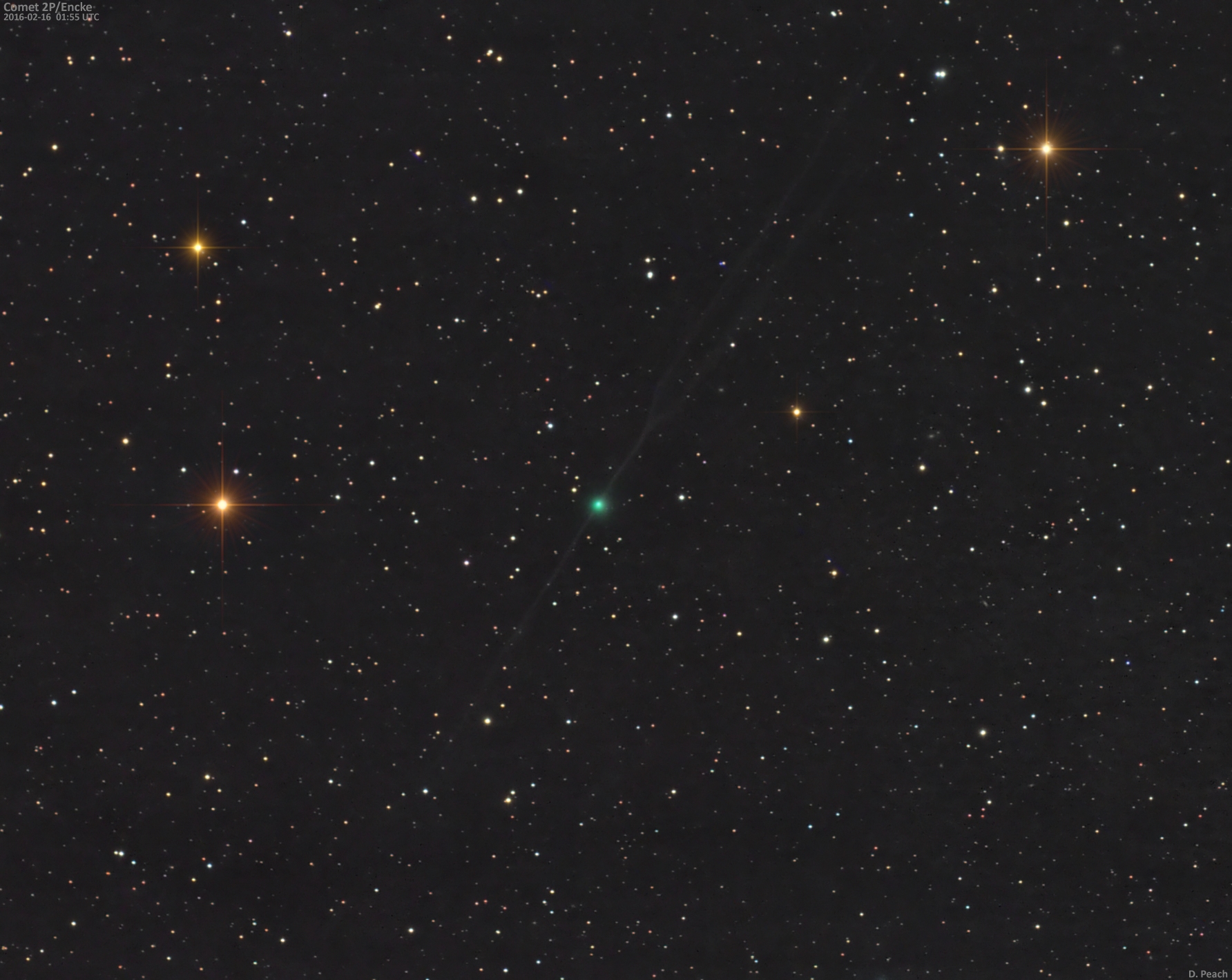
Almost Three Tails for Comet Encke


Almost Three Tails for Comet Encke 
 Image Credit & Copyright: Fritz Helmut Hemmerich
Explanation: How can a comet have three tails? Normally, a comet has two tails: an ion tail of charged particles emitted by the comet and pushed out by the wind from the Sun, and a dust tail of small debris that orbits behind the comet but is also pushed out, to some degree, by the solar wind. Frequently a comet will appear to have only one tail because the other tail is not easily visible from the Earth. In the featured unusual image, Comet 2P/Encke appears to have three tails because the ion tail split just near to the time when the image was taken. The complex solar wind is occasionally turbulent and sometimes creates unusual structure in an ion tail. On rare occasions even ion-tail disconnection events have been recorded. An image of the Comet Encke taken two days later gives a perhaps less perplexing perspective.

sexta-feira, 17 de fevereiro de 2017

Penumbral Eclipse Rising


Penumbral Eclipse Rising 
Image Credit & Copyright: Bill Jelen

Explanation: As seen from Cocoa Beach Pier, Florida, planet Earth, the Moon rose at sunset on February 10 while gliding through Earth's faint outer shadow. In progress was the first eclipse of 2017, a penumbral lunar eclipse followed in this digital stack of seaside exposures. Of course, the penumbral shadow is lighter than the planet's umbral shadow. That central, dark, shadow is easily seen on the lunar disk during a total or partial lunar eclipse. Still, in this penumbral eclipse the limb of the Moon grows just perceptibly darker as it rises above the western horizon. The second eclipse of 2017 could be more dramatic though. With viewing from a path across planet Earth's southern hemisphere, on February 26 there will be an annular eclipse of the Sun.